Most billing confusion comes from one mistake: using the wrong document name. A quote is not an invoice. An estimate is not a quote. A receipt is not a confirmation of an invoice. Each one carries a different commitment, and clients read them differently. Get the wrong one in their inbox and you either look amateur or you accidentally lock yourself into a price you can't deliver.
Here is a plain-English breakdown of every billing document a freelancer or small business uses, what it actually does, and the exact moment to send it.
Quote
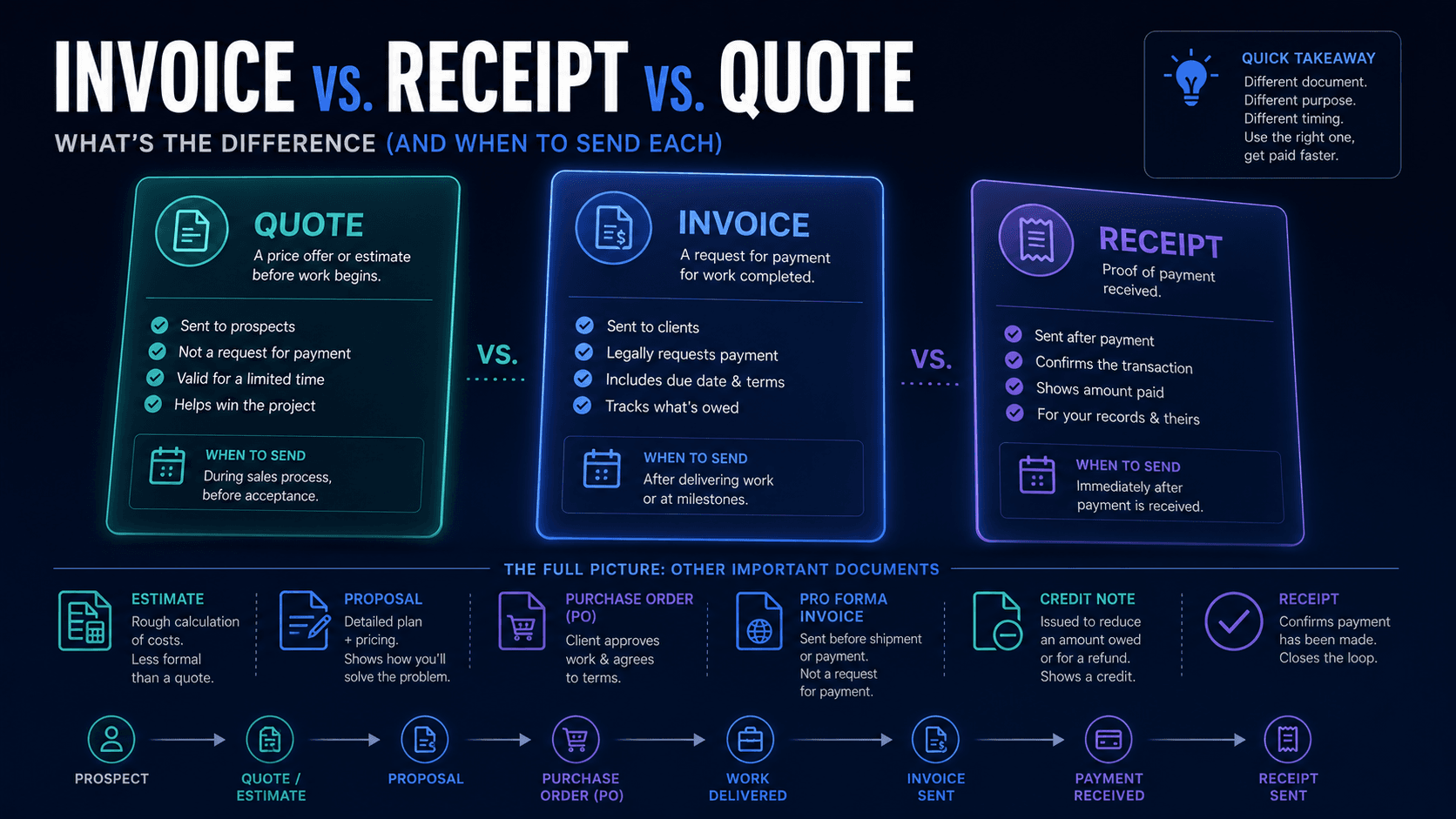
A quote is a fixed-price offer. You're saying: "If you accept this, the price is X." Once the client accepts, the quoted price is binding - you can't quietly raise it later. Use a quote when the scope is clearly defined and you're confident in the time it'll take.
- Includes: line items, prices, total, validity period, acceptance terms
- Sent: before any work begins, when scope is fixed
- Legal weight: binding once accepted
Estimate
An estimate is an educated guess. It's flexible by design. Use an estimate when you can roughly size the work but won't know the exact hours until you're inside the problem. Clients should know the estimate may change as scope clarifies.
- Includes: rough line items, ballpark prices, assumptions, range
- Sent: at the discovery stage when scope is still moving
- Legal weight: not binding, but should be honest
Proposal
A proposal is a quote with context. It explains the problem, your approach, the deliverables, the timeline, and the price - in that order. Use a proposal when the work is consultative or strategic and you need to sell your approach, not just your hours.
Purchase Order (PO)
A purchase order is the client's document, not yours. After accepting your quote or proposal, larger companies issue a PO that says: "We've approved you to do X work for Y dollars." The PO number then appears on your invoice. If a client uses POs, you can't invoice without one - your invoice will simply sit in a queue.
Invoice
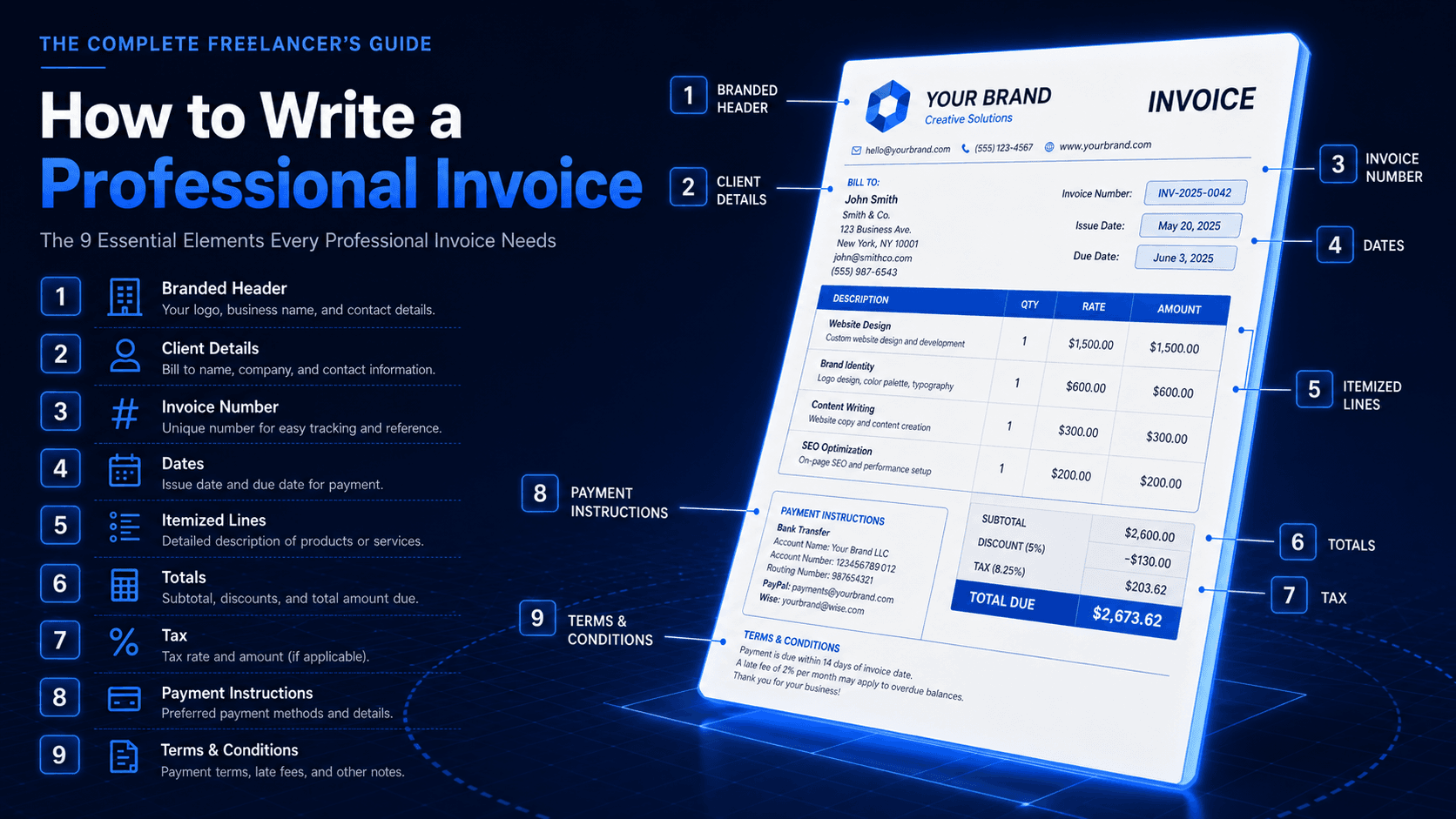
An invoice is a payment request, sent after the work is delivered (or after a milestone is hit). It says: "You owe me X, and here's exactly how to pay." An invoice is a legal financial record - both your tax authority and the client's will treat it as one.
- Includes: invoice number, dates, line items, totals, tax, payment instructions
- Sent: when the work (or milestone) is complete and payment is due
- Legal weight: an enforceable demand for payment
Pro forma invoice
A pro forma invoice looks like an invoice but isn't a payment request - it's a preview. Use it when the client needs to see what the final invoice will look like for internal approval or customs purposes, before goods or services are delivered. It's common in international trade and rare in pure-service freelance work.
Receipt
A receipt confirms payment was received. It comes after the invoice is paid, not before. A receipt is short - it just acknowledges the amount, date, and reference. It's the document the client will use to file expenses on their side.
- Includes: amount received, payment date, reference to the invoice number, payment method
- Sent: immediately after payment clears
- Legal weight: proof of settlement
Credit note
If you need to refund or reduce a previously-sent invoice, you don't edit the original - you issue a credit note. It references the original invoice and either reduces the amount owed or refunds an amount already paid. Editing a previously-sent invoice creates two versions of the same document, which is a bookkeeping nightmare at year-end.
The sequence in real life
Here's the typical document flow for a freelance engagement: a proposal goes out, the client accepts, optionally issues a PO, you do the work, you send an invoice referencing the PO, the client pays, you send a receipt, and the engagement closes. If something needs to be refunded mid-way, a credit note slots in.
Knowing the right document for the right moment is half of looking professional. InvoiceNexora handles the invoicing side cleanly - branded PDFs, sequential numbering, multi-currency, and status tracking - so the rest of your stack only needs to cover the quote and receipt steps.
Try InvoiceNexora
Send branded, professional invoices in under a minute.
Mobile-first invoicing for freelancers and small businesses. Templates, clients, multi-currency, and clear payment tracking - all from your phone.